

ON THE GRID AND OFF THE GRID: Q1 TREND ROUND UP FOR 2026
Updated: May 20

This report maps what's accelerating and what's losing cultural momentum in Q1 2026.
Using search behaviour, platform signals and digital consumption patterns, we identify where attention is consolidating (On the Grid) and where it's fragmenting (Off the Grid).
In an era where signal and saturation collide almost instantly, strategic advantage lies in knowing what to act on and what to let pass.
OFF THE GRID IN 2026
TREND CYCLES
The speed of culture has broken the traditional cycle of trends. Micro-trends now rise and collapse within weeks. Nostalgia returns in half the time it once did. Algorithms compress lifespans and accelerate fatigue. For Q1 2026, we argue that the old trend-cycle model no longer works.
Previous frameworks categorised trend cycles into three groups: fad, fashion, and classic. From our extensive SEO work, we know there are more than 3 cycles. We propose expanding this framework to include seasonal and nostalgia cycles. Adding these two new categories sharpens our ability to anticipate and act on shifting cultural attention. For businesses, this means better timing on campaigns and investments by understanding when a trend will resurface or fade within a season or nostalgia window. In short, we have identified five types of trend cycles:
Fad: trends with a short and sharp meteoric rise that fade away as quickly as they come. Think Barbenheimer, Labubus, viral videos.
Fashion: A repeated pattern of behaviour that generally lasts longer than a fad and is widely accepted by society.
Classic: Things that never go out of style, like Burberry trench coats, white T-shirts, and jeans.
Seasonal: Items or trends in style that are only available at certain times of year, such as festival fashion.
Nostalgia cycles: The 20-year rule, where vintage becomes cool 20 years later, such as Y2K fashion.
In January 2026, timelines filled with references to mid-2010s culture, millennial makeup, early Instagram aesthetics, and burger-joint optimism. Within weeks, it passed. A micro-trend rooted in nostalgia, already exhausted.
For brands, the challenge is no longer just staying relevant. It's knowing when relevance is worth acting on. Not every trend deserves a response. Not every spike signals opportunity. Brands that win will distinguish between noise and momentum and move at the right speed. To provide a practical filter, we recommend evaluating trends based on three criteria: search persistence (does interest last beyond a short surge?), multi-platform uptake (is the conversation growing across different channels or communities?), and relevance to brand positioning. By tracking these indicators, brands can better decide when to invest in a trend and when to let it pass.
Neutral and Clean Aesthetics.
As it does every year, Pantone announced its colour of the year. For 2026, the off-white shade Cloud Dancer was chosen. This announcement sparked significant online backlash and political commentary. 'Sounds about white', 'Is the colour in the room with us?' and 'Is this rage bait for creatives and artists?' appeared in the comments.
It's just a colour, though, right? It's also a signal of the public's attitude towards neutral trends. Trend cycles often show pendulum-like characteristics. When we have one thing for too long, we get 'trend fatigue' and swing the other way. For example, after the bright maximalism of the 80s came the grungy darkness of the 90s.
There is a growing critique of neutral or clean trends, and some journalists are even calling them problematic. Chelsea Candelario, writing for PureWow in February 2024, argues the 'clean girl aesthetic' is problematic because it alienates BIPOC women, fat women, women with acne-prone skin, women with disabilities, and older women. Online spaces are craving colourful and messy aesthetics, and we predict that as the year progresses, colourful and 'anti-clean' content will increase.
ON THE GRID
AI RESISTANCE
AI has been fully adopted into everyday life and work. 73% of the public have used AI in their day-to-day life in the past month. And yet, we do not fully trust AI. It's not an unfounded fear, as it can have a very real and dangerous impact on the world. Two-thirds of young adults aged 25-34 are worried AI will take their job one day. There are also significant concerns about its environmental impact and the singularity and amplification of human bias. So it's no surprise that there are countercultural movements that resist the spread of AI or at least hope to slow its use, especially in creative fields.
AI resistance has also reached marketing. Behind-the-scenes content engages younger generations because they trust it was not made with AI. Creative campaigns made with AI are seen as soulless and lacking depth, which is why they're called 'AI slop'.
Purely AI campaigns tend to lack depth and attention to detail. Elements of the advert often morph into one another. When Coca-Cola released AI-generated Christmas campaigns, backlash centred on two issues: the displacement of human creativity and the erosion of craft tied to a culturally significant moment. Many viewers felt something essential had been lost. The Coca-Cola advert once meant Christmas had arrived as a child, the closest you could get to having Santa in your living room. As one viewer put it, 'It just doesn't spark that same childhood magic anymore.' This response highlights the emotional heritage lost when brands swap tradition for automation.
Brands that foreground process, artistry, and human involvement are receiving disproportionate cultural approval. Campaigns that clearly show their artistic process are receiving praise from younger generations. In fact, campaigns that emphasise transparency and craft have seen engagement increase, and positive sentiment lifts compared to generic or AI-driven campaigns. This "process premium" translates into higher consumer trust and even higher sales conversion rates, showing that authenticity and visible effort are now key drivers of impact.
Apple's new TV intro, though it looks computer-generated, was shot without AI or CGI. It was created in a studio with a glass apple, natural light reflections, and flares. Apple wanted to showcase the artistry and published a behind-the-scenes video of its making.
MARKETING AS ART
Alongside AI resistance is a renewed appetite for marketing as artistic expression.
A shining example is the recent campaigns photographed by Szilvester Mako in collaboration with ABODI Transylvania. No AI was used, resulting in imagery that feels more like contemporary art than product marketing. ABODI's wearable art pieces sit at the intersection of gothic and whimsical, heavily inspired by Transylvanian folklore. Combined with Szilveszter Mako's artisanal photography, the result is not just a marketing campaign but a work of art. Szilveszter Mako has created art this way for years, but it’s the context of a new AI world that makes their approach stand out as an authentic piece of art. Audiences are recalibrating their perception of visual value in response to generative saturation.
This campaign has gained notoriety on social media, and Szilveszter Mako has photographed stars such as Rama Duwaji, Gwendoline Christie, and William Dafoe. The success of this style is undeniable. Amid a sea of slop on timelines, ABODI's campaign is a needed breath of fresh air. It breaks from AI slop and recalls a time before the 1940s, when marketing was art. It is beautifully executed and considered, in stark contrast to many campaigns today. In an era of accelerated content production, intentional craft stands out, and consumers want creative credibility.
Friction Maxxing
Friction maxxing is an emerging internet term for deliberately choosing less convenient options in daily life to build tolerance for discomfort, resist the lure of technology-driven ease, and preserve what proponents call meaningful human experiences. This means getting somewhere without using Google Maps, going out for groceries without Uber, or not using ChatGPT to reply to difficult conversations. Kathryn Jezer-Morton's article in The Cut was an early adopter of this term and encouraged readers to use it in daily life. She states that escapism is now redundant and Silicon Valley has turned humans into 'foie gras ducks being force-fed escapism'. The Guardian calls it 'character building', though the context has changed.
Interest in analogue technologies is not a novelty spike; it shows structural consistency. Search data for terms such as “dumb phone,” “vinyl records,” and “digital camera” reveals three important patterns. First, growth is not purely cyclical. While vinyl has seasonal lifts (particularly around Q4 gifting), baseline demand has trended upward over the past five years rather than returning to pre-2018 levels. Second, spikes in “dumb phone” and “flip phone” searches are not isolated events; they show repeated surges post-2022, suggesting renewed behavioural reconsideration rather than one-off curiosity. Third, much of this interest is youth-led, driven by Gen Z conversations about screen fatigue, attention-economy burnout, and digital overwhelm.
Graph 1: Trend data for the search term 'dumb phone' since 2004 via Google Trends.

Graph 2: Trend data for the topic' vinyl records' since 2004 via Google Trends.

Graph 3: Trend data for the topic 'flip phone' since 2021 via Google Trends.

Graph 4: Trend data for the topic' digital camera' since 2021 via Google Trends.
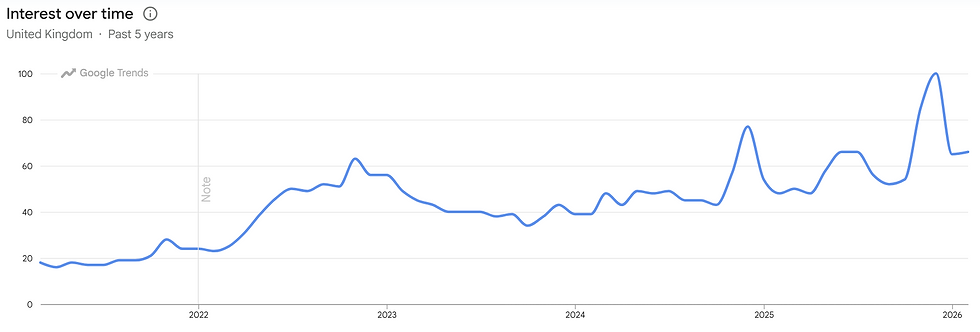
This is not a wholesale rejection of technology. It is a recalibration. Consumers are increasingly drawn to single-purpose device products that do one thing well and remove the pressure of constant connectivity. The appeal is constrained. In a hyper-optimised ecosystem where convenience has expanded to fill every idle moment, friction begins to feel restorative. The signal here is not anti-tech sentiment. It is selective adoption. People are not abandoning smartphones. They are questioning perpetual access.
To Conclude:
Q1 2026 showed us that cultural momentum is more volatile and fragmented than ever. The boundaries between fad and classic, technology and artistry, or relevance and overload, are being constantly redrawn in real time. Brands now face a decisive dilemma: is it better to act fast or to act meaningfully? Will you let trends dictate your moves, or define the direction yourself?
